The Rhode Island State House
McKim, Mead & White designed the State House in 1891–94. Construction ran from 1895 to 1904. Its Georgia-marble dome is a documented architectural feature.
The Tesla Files · Public-records initiative
Alan Gordon forwarded Rev. Dr. Anne Armstrong’s request asking federal officials to locate, review, and lawfully release records involving Nikola Tesla, John G. Trump, Wardenclyffe, McKim, Mead & White, and any references to the Rhode Island State House.
The request asks a question. It does not claim that a power-generating State House dome has been proven.
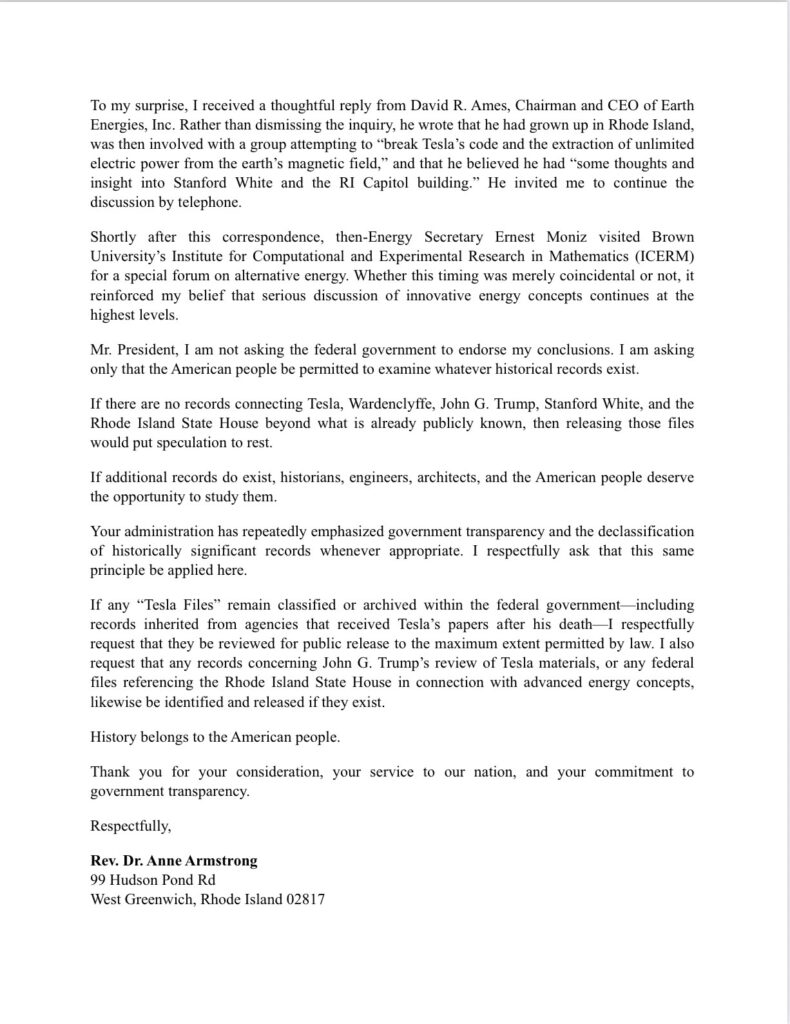
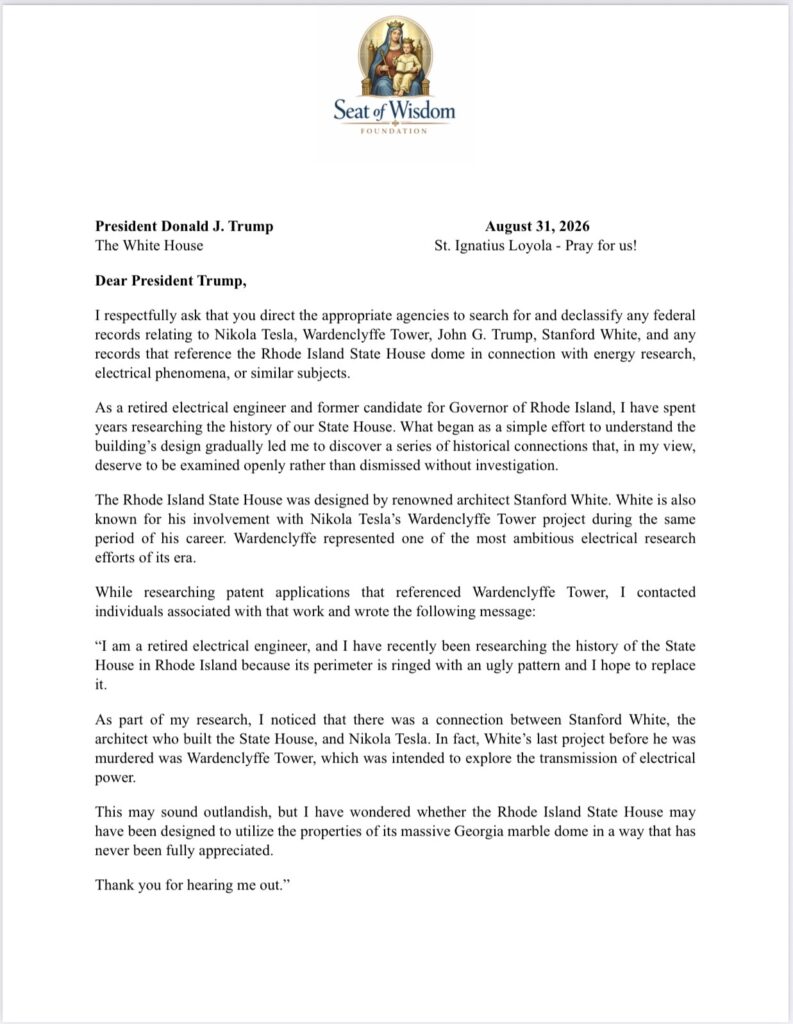
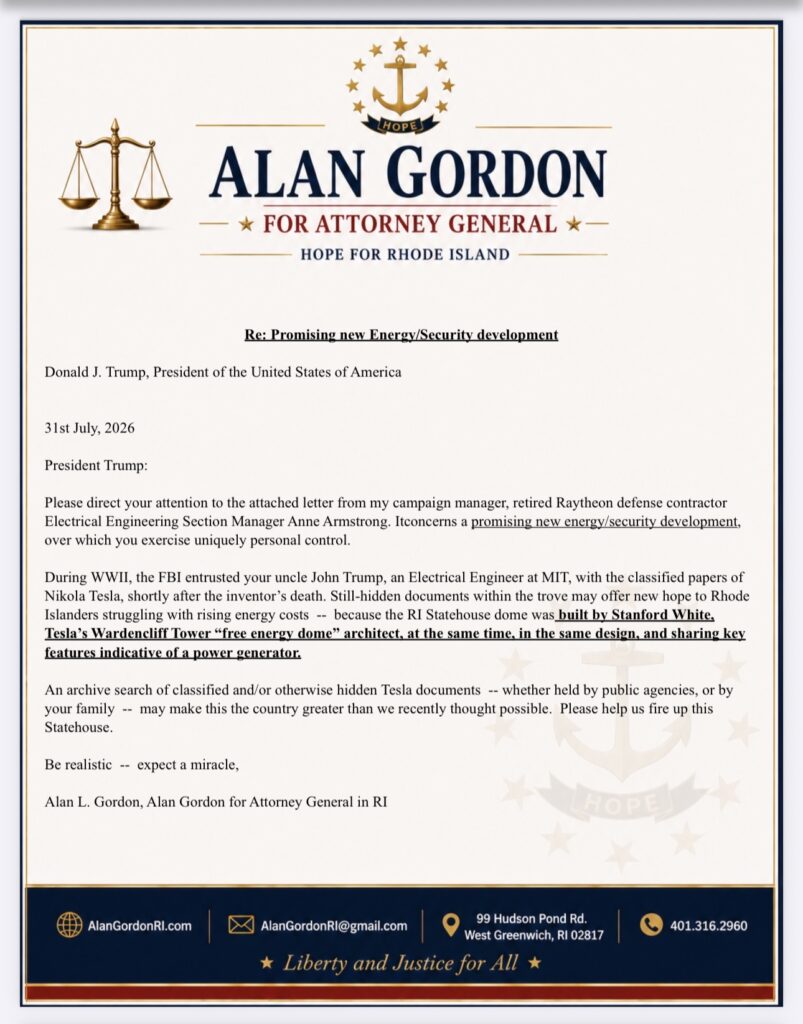 Original correspondence · July and August 2026
The architectural connection is documented.
The claim that the State House dome was designed as a power generator remains unproven.What the public record establishes
It begins with an architectural firm and an overlapping period—not with proof that two buildings shared an electrical function.
McKim, Mead & White designed the State House in 1891–94. Construction ran from 1895 to 1904. Its Georgia-marble dome is a documented architectural feature.
Tesla used Wardenclyffe as his laboratory and office while developing his proposed “World Wireless System.” McKim, Mead & White designed the laboratory and tower to Tesla’s specifications.
After Tesla died, the federal Alien Property Custodian Office temporarily seized his papers. Public federal records about Tesla are now available through the FBI Vault.
Anne Armstrong asked for a targeted search and lawful release of responsive records. Alan Gordon transmitted the request to President Donald Trump.
Evidence before conclusion
What the record supports
What it does not establish
A correction to the first cover letter
The July 31 cover letter said the FBI entrusted Tesla’s papers to John G. Trump. The FBI’s own published history gives a narrower account: the Department of Justice’s Alien Property Custodian Office temporarily seized Tesla’s papers, and the FBI says it did not search Tesla’s effects or possess the papers or related microfilm.
Correcting that point does not end the inquiry. It makes the next records request more accurate.
Read the FBI’s account ↗The work ahead
The purpose is to find and publish evidence—not to force the evidence toward a preferred answer.
Identify relevant holdings at the FBI Vault, National Archives, federal agencies, MIT collections, and Rhode Island archives.
Use names, dates, projects, agencies, and record series that reduce delay and avoid an unfocused search.
Publish the requests, agency correspondence, released records, and meaningful denials in one searchable public file.
If records justify further examination, use independent historians, architects, and electrical engineers. Any inspection of the State House must be authorized and non-invasive.
If the archives do not support the theory, that result belongs in the public record alongside any evidence that does.
The Attorney General’s role—and its limit
The office can advocate for release, help frame lawful and targeted requests, coordinate access to state-held records, protect public property and public money, and convene an independent review if the evidence warrants one.
No unsafe experiment. No predetermined conclusion. No public expenditure without an evidence-based purpose.
The original correspondence
The three pages are reproduced here so readers can judge the request for themselves. The factual clarification above is part of this updated public account.
Start with the primary record
Have a record or relevant expertise?
Send archival leads, technical analysis, or corrections. Submissions should identify their source and distinguish evidence from inference.