Pregnancy
It establishes the physical result, not consent, identity, or culpability.
Reproductive Justice Unit · A proposal for Rhode Island
Alan Gordon proposes that Rhode Island apply ordinary bodily-integrity and battery principles when a man causes pregnancy without a woman’s express consent—and place legal responsibility on the conduct that created the crisis.
“True reproductive justice holds the father accountable in law while protecting all innocent parties.”
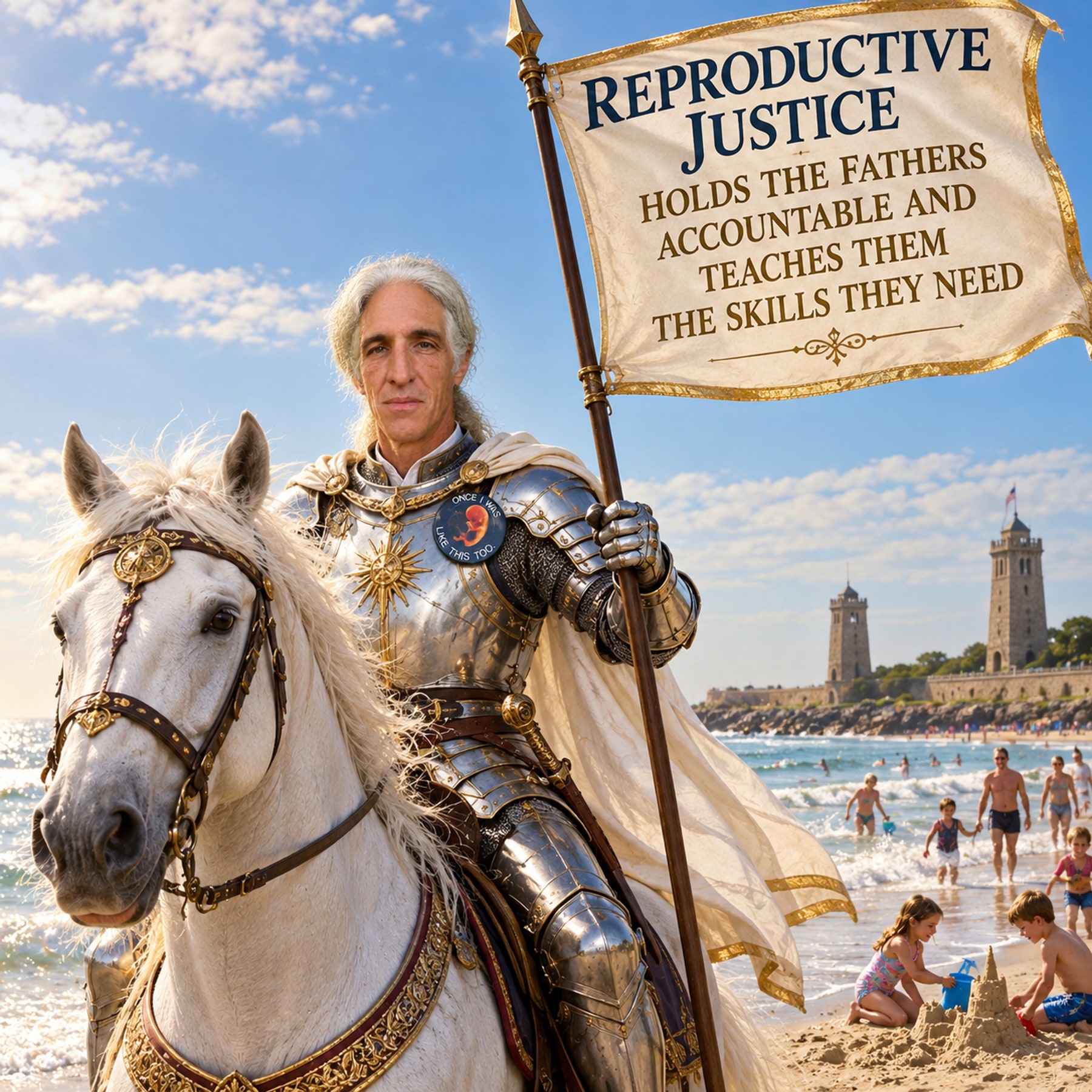
Protect the woman. Protect the child.
Hold the father accountable—and teach the man to become capable of fatherhood. Pregnancy changes her body. The law should not make his responsibility disappear.
The question that comes first
When a pregnancy is unwanted, attention turns almost entirely to the woman: what she will do, how she will manage the medical consequences, and whether she can support a child. The conduct of the man who caused the pregnancy often vanishes from view.
Alan’s proposal asks a prior question: Did she expressly consent to being made pregnant by that man? If not, did he knowingly disregard a foreseeable risk and cause the pregnancy anyway?
A woman retains control over what happens to her body. A man remains responsible for what his actions cause. A child is not made responsible for either adult’s decisions.
A defined allegation—not automatic guilt
The proposal does not make pregnancy, paternity, or a complaint conclusive. Every required element must be established with lawful evidence under the applicable criminal standard.
The physical result must exist. Pregnancy itself is not proof of wrongdoing.
The issue is consent to pregnancy—not merely consent to sexual activity. Communication and surrounding facts matter.
Paternity or other lawful evidence must establish causation as to the particular defendant.
Authorities must prove the voluntary conduct and culpable state of mind required by applicable law; a genuine unavoidable accident is not enough.
Due process stays in place
It establishes the physical result, not consent, identity, or culpability.
A complaint may begin an investigation. It is not a conviction.
Biological causation does not prove the required state of mind.
Miscarriage, birth, medical treatment, or a later change of mind does not decide what was consented to at the relevant time.
Facts, not slogans
There is no single shortcut. The evidence must show what was communicated, what each person knew, what conduct occurred, and whether that conduct caused the pregnancy.
Contraception is relevant evidence, not a verdict. Its use can show that pregnancy was being avoided. The proposal argues that accepting a method’s known failure rate is not the same as consenting to the result that method was intended to prevent.
The legal argument—and its present limit
Rhode Island decisions define battery as an act intended to cause, and causing, offensive contact, unconsented touching, or trauma. They also explain that an intent to injure is not always required when a person willfully sets a force in motion that ordinarily causes injury; the contact itself must still be intentional.
The proposal argues that intentional reproductive conduct, lack of express consent to pregnancy, foreseeability, causation, and a resulting pregnancy should be examined under those principles rather than placed outside them automatically.
No Rhode Island appellate court has decided this precise question. This is a proposed application of existing principles, not a claim that the theory is already settled law. A responsible Attorney General would test the argument against the statute and precedent, bring only cases supported by admissible evidence, and seek legislative clarification if existing law does not reach the conduct.

For appropriate first offenders
For a qualifying first offender, the proposal favors a lawful, rigorous diversion option rather than incarceration alone. The purpose is to build the discipline and practical capacity needed for responsible adulthood and fatherhood.
Qualified nonprofit and faith-based organizations could participate under public standards. No participant would be required to profess a religion. Completion would operate only through lawful diversion, filing, deferred-disposition, dismissal, or sentencing authority.
A path back to responsibility
Responsibility toward a child never creates an entitlement to a relationship with the mother. Her safety and freedom remain separate.
Work history, skills, education, finances, housing, parenting experience, and behavioral needs.
Structured living or comparably intensive training combining work, instruction, service, and discipline.
Transition into an ordinary job or apprenticeship, with independence as the objective.
Where legal parental duties exist, demonstrate the practical ability to contribute to the child’s support.
Court recognition under whatever lawful diversion or sentencing mechanism applies.
Questions the complete paper answers
The full paper addresses 45 objections. Open a few of the central ones below.
The proposal argues for consistent application of existing battery principles, not a special offense called “pregnancy.” Whether current Rhode Island law reaches a particular case remains a legal question for prosecutors and courts; legislation may be needed to clarify the rule.
Recklessness does not require certainty. Foreseeability, the seriousness of the consequence, knowledge of the risk, and disregard of that risk all matter. The prosecution would still have to prove the mental state required by law.
Use of contraception can be evidence that pregnancy was being avoided. It does not by itself prove the man’s guilt, and knowledge that a preventive method can fail is not necessarily consent to the outcome it was used to prevent.
A later change cannot retroactively erase consent that actually existed. The inquiry concerns what was communicated and understood at the relevant time.
A genuinely reasonable belief that pregnancy could not occur may negate the required mental state. A belief that pregnancy was merely unlikely presents a different factual question.
No. The child is innocent. The legal question concerns the physical condition imposed on the woman and the conduct that caused it; recognizing a wrong does not diminish the worth of the child.
No. Any program must be voluntary where the law requires, operate under lawful court authority, meet constitutional standards, and focus on vocational education, structured service, discipline, and rehabilitation—not extraction of labor.
What Alan would do as Attorney General
The authoritative source
This webpage is a reader’s guide. The document below contains the full argument, definitions, safeguards, diversion framework, and all 45 objections and responses developed for this initiative.
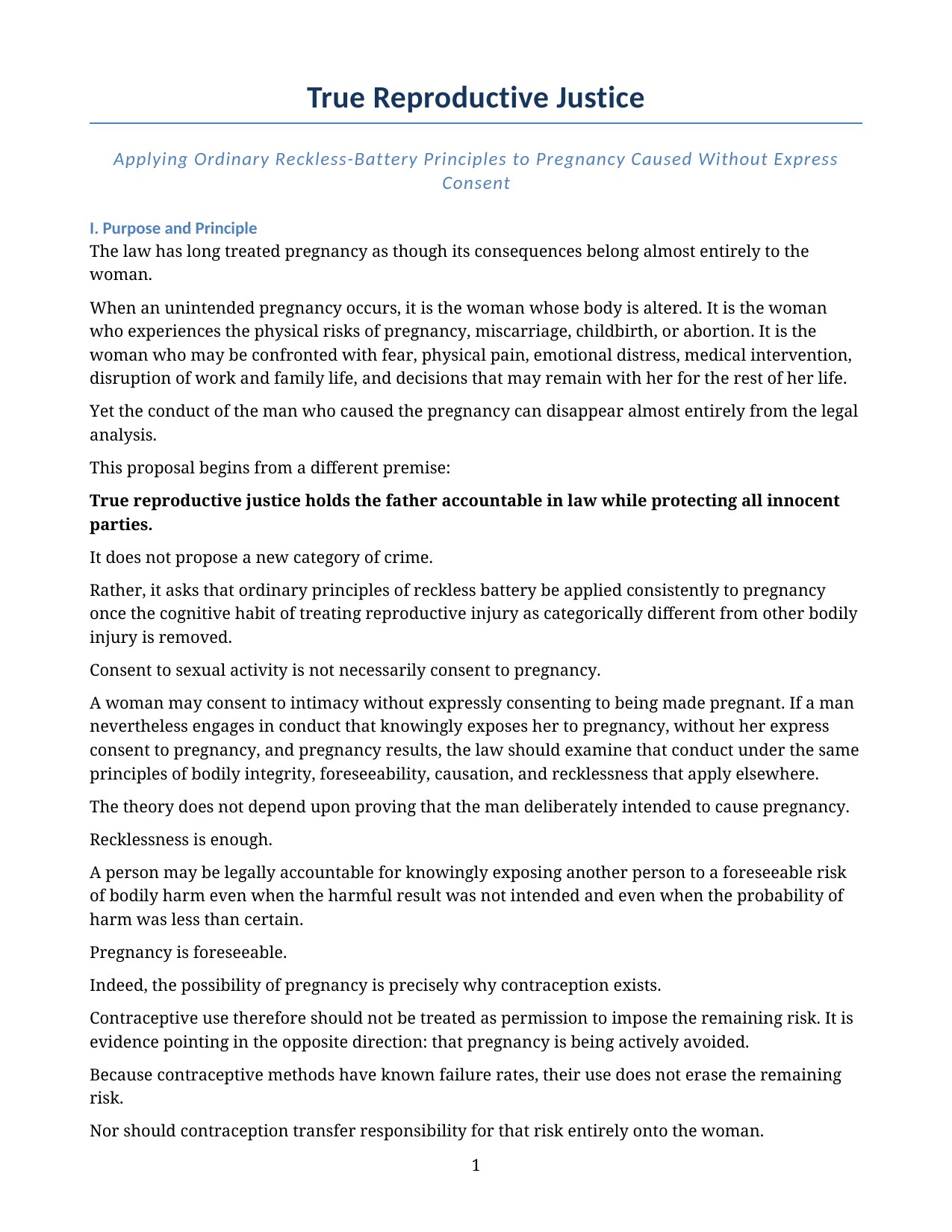 True Reproductive Justice19 pages · PDF
Primary legal and medical materials
A proposal worth debating on its merits
Read the paper. Test the reasoning. Send a legal objection, a practical improvement, or an offer to help build a responsible Rhode Island model.